|
THE PILL (oral
contraceptives)
| |
| What
is "the Pill"? |
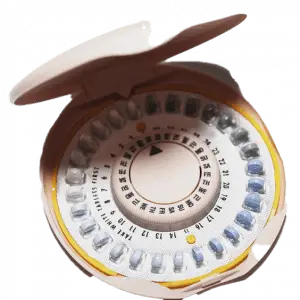
| Combined oral contraceptives
are commonly known as "the pill". They
contain two man-made hormones called
estrogen and progestin. The various
brands of pills differ ONLY by the amount
of estrogen in each pill and by the
type and amounts of progestin. Some
pills contain a constant dose
of hormones while others are phasic
in which the amount of hormones change
to mimic your natural menstrual cycle.
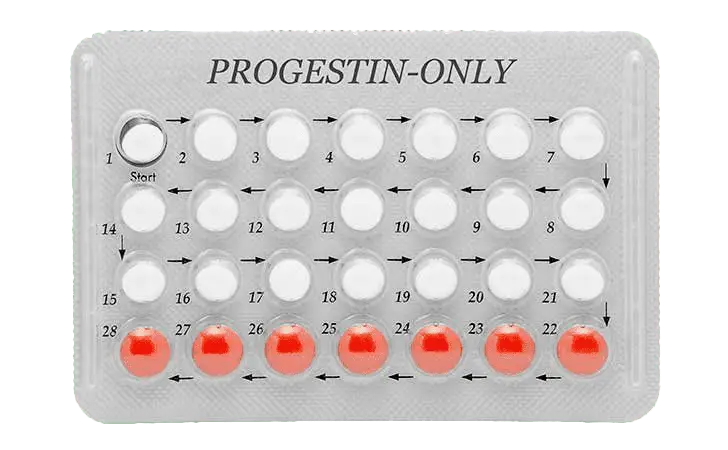
Each package contains 21 hormonally
active pills followed by 7 placebo pills
(28-day regimen) or 7 days of taking
no pills (21-day regimen). |
| |
|
|
| |
| How
does the Pill work? |
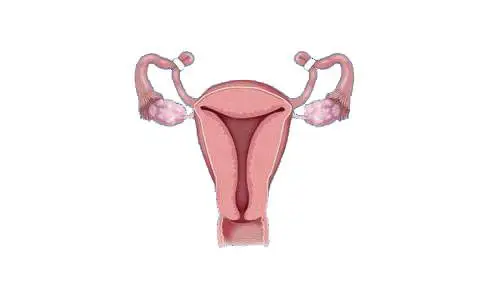
| The pill prevents ovulation,
which is the release of eggs from the
ovaries. It also causes thickening
of the cervical mucus to block sperm
from entering the cervix and affects
the lining of the uterus to prevent
implantation of the pregnancy. |
| |
|
|
| |
| How
effective is the Pill? |
| Among perfect
users (women who miss no pills and follow
instructions perfectly), only about
1 in 1000 women will become pregnant
over the first year of use. Among typical
users, about 3 to 5 in 100 women
will become pregnant over one year of
use. Pregnancy rates during typical
use are based on the number of missed
pills and delay in starting the next
pill pack. |
| |
|
|
| |
| Am
I a good candidate for the Pill? |
| Most healthy women
of reproductive years are good candidates
for the pill regardless of prior pregnancy
history if interested in birth control
and are able to take a pill every
day. This includes teens, overweight
or underweight women, diabetics without
underlying heart disease, women with
family history of breast cancer, women
over 35 who are non-smokers, and smokers
under 35 (however, it is best NOT to
take the pill and smoke!) The
pill does NOT protect from sexually
transmitted diseases particularly HIV.
If this is a concern you should also
use a condom |
| |
|
|
| |
Are
there any reasons why I shouldn't
use the Pill?
A woman
should not use the pill if she
has history of: |
 |
stroke or other
diseases of the blood vesses |
 |
blood clots in
the lungs or legs |
 |
heart attack |
 |
active liver
disease |
 |
migraine headaches
with changes in vision or tingling/numbness
in the extremities |
 |
age over 35 years
and a smoker |
 |
current or past
history of breast cancer |
|
|
| |
|
|
| |
| Which
Pill is right for me? |
| There is no exact formula
to determine which particular pill is
best for you-every woman responds differently
to different pills. Despite advertising,
essentially all oral contraceptives
work equivalently well. For you, the
best pill is the one with the least
amount of estrogen that does the job.
In addition to protecting you from pregnancy,
the pill should regulate your periods
and some women do need more estrogen
for this purpose. Price is another
consideration. Most pills are $25-$35
or more per month. Many health insurance
prescription plans do not cover birth
control pills. The more popular, better-advertised
pills can be more expensive. There
are equally effective and appropriate
pills for you that are less expensive.
There are also programs available such
as femScript which subsidize the cost
of the pill. Ask about these alternatives. |
| |
|
|
| |
| What
are the most common side effects of
the Pill? |
 |
Many of the side
effects from the pill are due
to the estrogen component and
usually resolve within the first
few months of starting the pill.
Thus, new pill starters are encouraged
to try the pill for at least 3
months. |
 |
nausea |
| |
Caused by the
estrogen component. Try taking
the pill at night or with a snack.
You may benefit from starting
with the lowest estrogen dose
(20 mcg) pill. |
 |
breast tenderness |
| |
Both the estrogen
and progestin components of the
pill may contribute to breast
tenderness. Eliminating caffeine
and chocolate from your diet may
help. |
 |
menstrual
changes |
| |
Breakthrough
bleeding or any irregular bleeding
may occur within the first 3 months
of use, especially if you have
missed pills or are not
taking them at the same time each
day. Breakthrough bleeding does
not decrease the effectiveness
of thepill provided you are taking
them daily. If this persists
after 3 months, often a change
to a higher dose pill or simply
a different brand will help.
If intermenstrual bleeding persists,
you may need to be checked for
other causes of bleeding unrelated
to pill use. |
 |
headache |
| |
If you develop
headaches while on the pill, these
need to be evaluated by your doctor.
If you suffer from any neurological
symptoms such as changes in vision
or tingling/numbness in your extremities
then you should immediately discontinue
the pill asestrogen will increase
your risk of stroke. If headaches
continue or worsen without neurological
complaints, you may want to switch
to the lowest dose estrogen pill
or simply a different formulation.
Women who suffer from menstrual
migraines usually benefit from
being on the pill. |
 |
hypertension |
| |
The pill may
cause an increase in blood pressure
in some women. New users should
have their pressure checked 3
months after starting the pill
and all women should have it checked
at each doctor's visit. Women
with a known history of hypertension
that is well-controlled on medications
may be able to take the pill but
should consult with their primary
care doctor. |
 |
gallbladder
disease |
| |
The pill may
stimulate the growth of gallstones
in women with existing gallbladder
disease. |
|
| |
|
|
| |
| What
are the benefits of the Pill? |
 |
more regular
and predictable
menses |
 |
decrease in the
number of days of bleeding and
amount of blood loss each
month |
 |
decrease in menstrual
cramps |
 |
decreases acne
(all brands decrease testosterone
which decreases acne) |
 |
improves hirsutism
(excessive hair growth) |
 |
decreases benign
breast disease (fibroadenoma
and cystic changes) |
 |
lifetime decrease
risk of ovarian cancer by
40% continuing at least 15 years
after use |
 |
lifetime decrease
risk of endometrial cancer
by 50% |
 |
decreased risk
of colorectal cancer in
current users and within 10 years
of use |
 |
desirable effect
on cholesterol;
increases the good cholesterol
while decreasing the bad cholesterol |
 |
preserves bone
density and possible reduction
in osteoporosis |
|
| |
|
|
| |
| When
do I start the Pill? |
|
You
must wait for your next period to
ensure that you are NOT pregnant when
you start the pill. You can start
EITHER:
Day-1
start: on the first day of bleeding
Sunday
start: on the Sunday following
the first day of bleeding
If
you start the pill on a Sunday you
will NOT get your period on the weekend.
If you start the pill within the first
five days of your period you
will be protected from pregnancy that
first month and not need a back-up
method. You can use the following
regimen to benefit from a Sunday
Start and still have immediate
protection from pregnancy. If your
period starts on a Monday or Tuesday,
this regimen will shorten your cycle
by one or two days, which is not harmful
to you. Then start your next and
all subsequent pill packs on the Sunday
following completion of the prior
pack.
|
If
your period starts on Sunday
|
If
your period starts on
Monday
|
If
your period starts on Tuesday
|
If
your period
starts on
Wednesday
|
If
your period starts on Thursday
|
If your period starts on Friday
|
If
your period starts on Saturday
|
Following
Sunday
|
|
Start pill today |
Throw out Sunday's pill, start
today with Monday's pill
|
Throw out Sunday and Monday's
pills, start today with
Tuesday's pill |
Start pill the following Sunday
|
Start pill the following Sunday
|
Start pill the following Sunday
|
Start pill the following Sunday
|
Start today |
The pill may be started
after the end of a pregnancy. You may
start the pill the Sunday after a termination
of pregnancy. It will then be effective
two weeks later when it is generally
safe to return to sexual activity.
You may experience irregular bleeding
the first month due to both healing
from the procedure itself as well as
your body getting use to the hormones.
You
may also start the pill after a full-term
pregnancy. If you do NOT plan to breast
feed the pill may be started on the
Sunday three weeks after delivery
and will be effective by the sixth
postpartum week when it is generally
safe to return to sexual activity.
In women who choose to breastfeed,
the estrogen component of the pill
may decrease the milk supply, thus
progestin-only pills are recommended
and are initiated after 6 weeks when
the milk supply is well-established.
|
| |
|
|
| |
| How
do I take the Pill? |
| You must take one (active)
pill everyday. Most packs contain 3
weeks of hormonally active pills followed
by one week of inactive pills (or 7
days of taking no pills) during which
time you will get your period. The
placebo pills serve as a reminder to
get you into the habit of taking a pill
every day and not forgetting to start
your next pack. Try linking it to something
you do the same time every day
(i.e. brushing your teeth before going
to bed). |
| |
|
|
| |
| What
If I miss a Pill? |
|
If you miss any of
the inactive pills throw out
all pills missed. If you miss any
of the hormonally active pills:
Missed
1 pill in any week. Take the
missed pill NOW and the next pill
at the usual time (this may entail
taking 2 pills now). You will be
protected from pregnancy but may have
some breakthrough bleeding or spotting
for the remainder of the pill pack.
This should resolve when you start
your next pack.
Missed
2 pills in week 1 or 2. Take
2 pills NOW and 2 pills tomorrow.
Then take 1 pill a day until you finish
the pack. Use a backup method of
contraception (i.e. condom) for the
next 7 days. Again you may have some
bleeding or spotting for the remainder
of the pill pack.
Missed
2 pills in week 3 or missed 3 or more
pills. For Day-1 Start:
Throw out pack. Start new pack the
same day. Use a backup method for
7 days. For Sunday Start:
Take 1 pill each day until Sunday.
On Sunday, throw out the old pack
and start a new pack. Use a backup
method for 7 days.
If
you do miss 2 or more pills and are
concerned you may be pregnant, emergency
contraception or the "morning-after
pill" is available. This must be
taken within 72 hours (or 3 days)
of unprotected intercourse. You may
call the office to receive this form
of contraception. Of note, this is
only intended for occasional use and
not as a regular method of birth control.
|
| |
|
|
| |
| Are
there any warning signs I should look
out for once I start the Pill? |
| Call your doctor if
you have any of the following problems:
severe abdominal pain; severe chest
pain (shortness of breath or sharp pain
on breathing); severe headache, dizziness,
weakness or numbness, especially if
one sided; eye problems (vision loss
or blurring), speech problems; or severe
calf or thigh pain. |
|